 Loading... Please wait...


Products
Products
Topic of the Month: Balinese Jewelry Making Techniques - How It Gets Made
Posted by on

Have you ever wondered how Balinese jewelry gets made? Have you wondered how much goes into it? Have you ever wondered how many hours, and what kinds of techniques are used to make a Borobudur chain, or a bracelet, or even a ring? In this month’s featured topic, we are going to explore just a few of the ways that jewelry gets made in Bali.
The history of jewelry making in Bali is an old tradition, as some of the techniques date back as far as 400 years. It used to be that smiths would work primarily in gold, crafting gold pieces for the royal family. Sterling silver was not used for jewelry, and instead served more ceremonial purposes such as ceremonial bowls, or boxes. It wasn’t until as recently 35 to 40 years ago that the demand for silver jewelry with Balinese design rose. We will briefly touch on a few jewelry making techniques.
Snake Weave: This weave is used to make bracelets. In Bali, they refer to this as the “Tulang Naga.” The smith starts with a thick iron board that has multiple holes in it, varying in sizes and shapes. The smith will take Sterling silver and pull it through these holes with a pair of pliers, using whichever holes the smith desires to get the necessary thickness and shape. As the silver is pulled through, excess silver is cut away to give it a smooth feel. Once the smith has all they lengths he needs, he will begin to weave them together very tightly, while still maintaining the smooth finish. Next, the chain is oxidized, which is a discoloration process that is distinctly Balinese, and responsible for the unique finish. At last, a polish is given so that only the areas in between the links remain oxidized. The finishing touches include cutting the chain to its exact length, and then adding ends and the appropriate toggles.
Granulation: Another very unique aspect of Balinese jewelry design is what is called granulation. Granulation is little sphere shaped pieces of silver added to a piece of jewelry, usually as a way to accent some kind of centerpiece in that item. It is also usually accompanied by what is called scroll work, but we use the term filigree here in the West. In order to create these little spherical shapes, small little cuts of silver are put into a smelting pot and heated to the point of boiling. Once they reach that point, the little silver pieces become little spheres, and are removed so they can cool. Think of it like you are taking a sheet of cookies out of the oven. Each individual sphere can then be taken and applied carefully through soldering, as the smith desires. The expertise of the smith is shown in the deftness of his dexterity: each individual sphere is picked up with tweezers, and is also soldered in individually, with no residue left over. These can take days to complete.
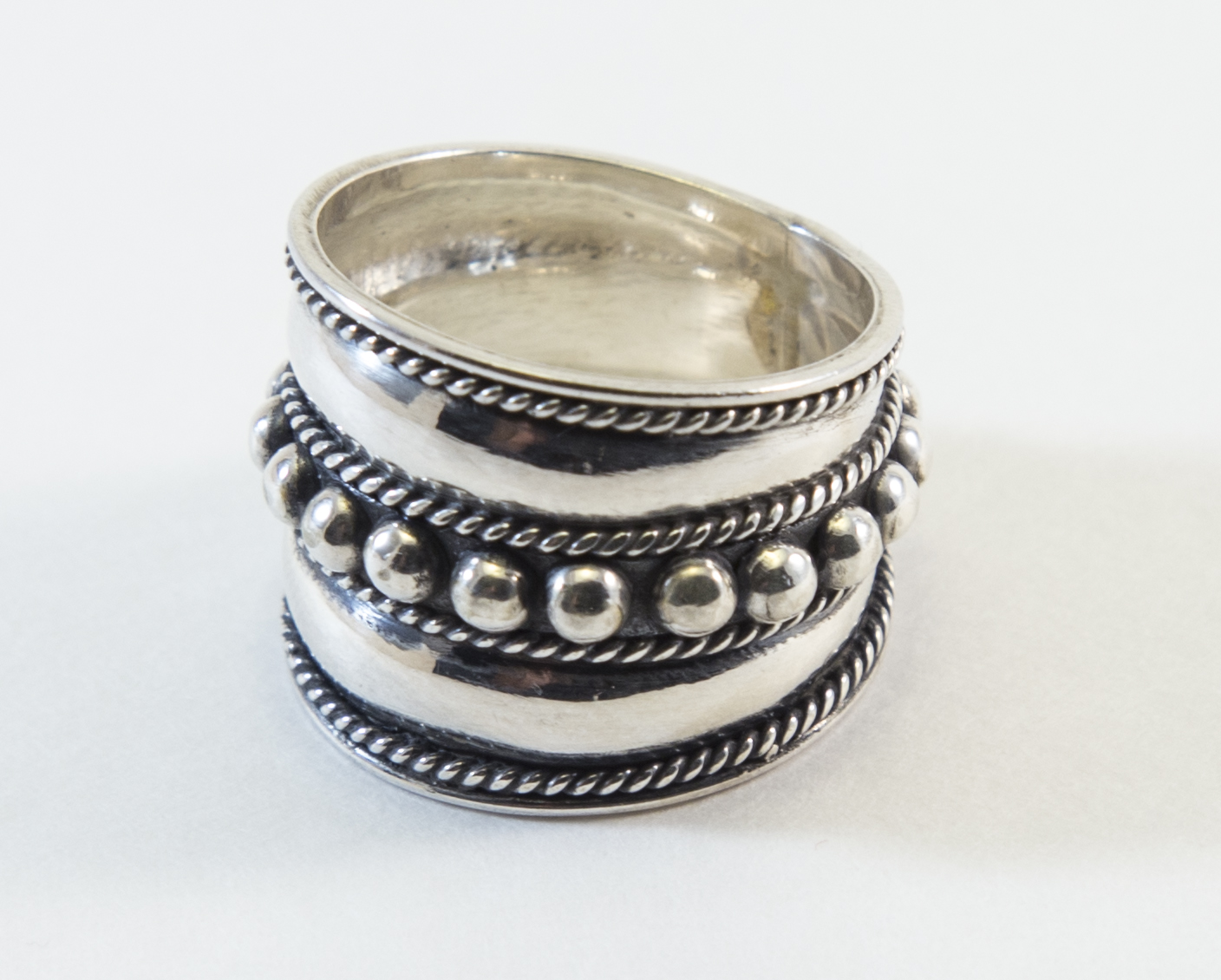
Dot Technique: The dot technique is a natural progression from the granulated technique. Just like the granulation technique of creating small silver spheres, the dot technique then takes those spheres and places them an iron plate; they are then hammered down very neatly. This results in a perfectly flat disc shape. These dots can be applied in any fashion. The smiths are also artisans; they make creative decisions in how they make the pattern. When the dots are used, smiths always use oxidation around it as a contrast in order to bring more emphasis to the pattern.
Borobudur: Borobudur chains are among the most recognizable and unique parts of Balinese jewelry design. It also happens to be a painstakingly detailed process. The smith starts by taking silver wire and turning it to create a coil shape. The smith then snips them off to make the rings needed for the links. Each silver ring is layered together to start forming the pattern of the Borobudur chain. This results in the basic shape of what will be the final chain. The next phase is heating the silver chain and adding silver where needed to make the correct design. This makes the links much closer together, and are very carefully accentuated with a hammer. Next, the links are blackened in between each other, finally finished up with a deep polish. These techniques are consistently applied to all Borobudur chains 10MM and under.
Information sourced from: http://www.silvernomad.co.uk/pages/Bali-Silver-Jew...