 Loading... Please wait...


Products
Products
Topic of the Month: Opal - the October Birthstone
Posted by on
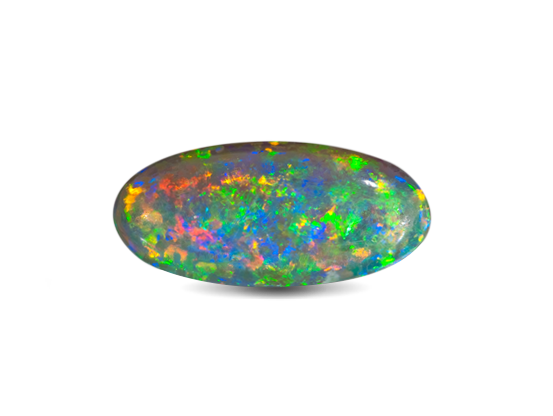
It’s October, so why not talk about Opal? After all, it is the birthstone for this month. It is one of the most unique stones in the world. Let’s see what we can learn.
How is opal formed? The answer is actually quite fascinating. Opal is natural result of seasonal rains that fall in very dry areas, such as Australia’s outback. The rains would soak deep into the underground rock, carrying dissolved silica down with it. Once it got dry again, the majority of the water would evaporate and still leave behind the deposits of silica in the cracks and between the underground rock sediments. These silica deposits are what forms the opal!
Furthermore, opal is known for it’s rainbow like colors that radiate out of it, known as “play-of color.” Opal is broadly classified into 2 different categories: precious and common. Precious opals have the play-of-color, while common opal does not. The reasons play of color shows up in precious opal is due to layers of sub-microscopic spheres stacked in a grid-type pattern, almost like a bunch of ping-pong balls in a box. Light travels through these spheres, and the light diffracts (bends), breaking up the color that appears as play-of-color. The color that appears is going to be depend on the size of these spheres, with colors ranging from violet to red, to everything in between.
Experts tend to divide opals into about 5 main categories of color, and they are as follows:
- White opal
- Black opal
- Fire opal
- Boulder opal
- Crystal opal
Crystal opal tends to display the most spectacular play-of-color of all opals.
Opal also carries with it a certain lore in different cultures. In Roman culture, it was regarded as a symbol of love and hope. They even named it “opalus,” a name that basically meant “precious stone.” A Roman scholar wrote in 75 AD about how opals carry the deepest and richest colors of painters, while others “the bright blaze of burning oil.” Other cultures look at opal as though its origins are supernatural as well as its powers. Arabic legends talk about opal falling from the sky in flashes of lightning, while Ancient Greeks regarded it as giving people the ability to prophesy, and to protect them from disease. Europeans look at the stone as a symbol of hope, purity, and truth. The superstition that is unlucky for a non-October born person to wear opal does not come from any ancient cultures, but rather from a novel written in the early 1800s, Anne of Geierstein by Sir Walter Scott. All the other cultures regarded opal as the luckiest of stones, which is quite the opposite!
Opals only occur in a few places on the earth: Nevada, Mexico, Brazil, Peru, Ethiopia, and of course, Australia.
That’s a little bit about opals – the rainbow stone!
To read more in depth, check out these sources we used:
https://www.gia.edu/opal#gem-overview